Binary fractions are nutty, yet they’re an important part of understanding how real numbers are stored in a computer. Continuing from last week’s Lesson, here I compare my results of fraction translation with values stored in the binary32 format used by the computer. Doing so requires some manipulation — and some assistance from our old pal, the C language union.
The problem with comparing my binary fraction interpretation with what’s present in a real number’s bit pattern is that the bits in the binary32 format are shifted based on an exponent value. Further, the leading ‘1’ is removed from the resulting number. (The leading 1 bit is “assumed” in this format.)
For example, here’s output for the fraction 0.375 from the code presented in last week’s Lesson:
Enter a positive decimal: 0.375
0.011
The value 0.375 is stored in the binary 32 format as this bit pattern:
00111110110000000000000000000000
Figure 1 shows how these bits sort out.
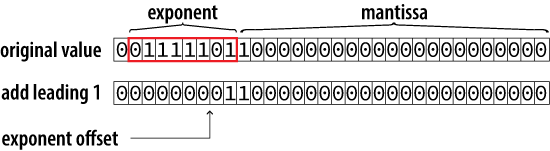
Figure 1. How the fraction is extracted from the binary32 format.
In the figure, you see the sign bit is 0, positive. The exponent is 0x7D. The mantissa is 0x400000. To compare the result from my code in last week’s Lesson with the fraction as stored in the binary32 requires some manipulation. This job is handled in the following update to the code from last week’s Lesson:
2026_11_21-Lesson.c
#include <stdio.h>
#include <stdlib.h>

/* output binary representation of the fraction */
void binout(unsigned b)
{
    int x,exponent;

    /* extract exponent */
    exponent = b & 0x7F800000;
    exponent >>= 23;
    /* undo the standard bias of 127 */
    exponent -= 127;
    /* mask out the sign and exponent */
    b &= 0x00EFFFFF;
    /* add the "assumed" leading bit */
    b |= 0x00800000;

    /* output binary decimal */
    printf("binary32: 0.");
    for( x=0; x<32; x++ )
    {
        /* account for exponent shift, max 9 places */
        if( x>=9+exponent )
            putchar( b & 0x80000000 ? '1' : '0' );
        b <<= 1;
    }
    putchar('\n');
}

int main()
{
    union real {
        float f;
        long l;
    } numb;
    int x;

    /* gather input */
    printf("Enter a positive decimal: ");
    scanf("%f",&numb.f);
    if( numb.f>=1.0 )
    {
        puts("Enter a value between 0.0 to 1.0");
        return(-1);
    }

    /* output original binary value */
    binout(numb.l);

    /* process fraction */
    printf(" extract: 0.");
    for( x=0; x<32; x++ )
    {
        numb.f *= 2.0;
        if( numb.f==0 )
            break;
        if( numb.f>=1.0 )
        {
            putchar('1');
            numb.f -= 1.0;
        }
        else
            putchar('0');
    }
    putchar('\n');

    /* clean-up */
    return 0;
}
The binout() function outputs a string representing the binary values stored in the fractional part of a binary32 formatted real number. It accomplishes this task in several steps.
First, the exponent value is extracted:
exponent = b & 0x7F800000;

exponent >>= 23;
The bitwise & operator masks out the exponent value, which is then shifted 23 places right. This process is described in a previous Lesson. Because the value is based on the standard bias of 127 (per the binary32 format), it must be adjusted to obtain the true exponent value:
exponent -= 127;
The result determines how the binary fraction is shifted, left or right based on the exponent’s sign.
Next, the binary fraction is pulled from the rest of the number:
b &= 0x00EFFFFF;
The bitwise & masks out the binary fraction. But the leading 1 bit is assumed, so I add it back in with a bitwise | (OR) operator:
b |= 0x00800000;
The remainder of the code outputs the binary fraction, but only given the offset provided by the exponent value in variable exponent. This value shifts the number’s starting position when the result is output inside the for loop.
The goal of all these steps is to compare the binary fraction as it’s stored in the binary32 format against what my code generated from last week’s Lesson. Here’s a sample run:
Enter a positive decimal: 0.375
binary32: 0.0110000000000000000000000
 extract: 0.011
The values match. Here are a few more examples that match:
Enter a positive decimal: 0.625
binary32: 0.101000000000000000000000
 extract: 0.101

Enter a positive decimal: 0.1
binary32: 0.000110011001100110011001101
 extract: 0.000110011001100110011001101
But not all fractions match:
Enter a positive decimal: .999
binary32: 0.111011111011111001110111
 extract: 0.111111111011111001110111

Enter a positive decimal: 0.825
binary32: 0.110000110011001100110011
 extract: 0.110100110011001100110011
For the fractions 0.999 and 0.825, you see an extra bit in my output verses what’s output from the binary32 format. I explain the funkiness behind this discrepancy in next week’s Lesson.